The Team I Never Had Before
What one week of building with AI finally made real
Last week I ran an experiment. I wanted to know if two AI tools - Codex and Claude Code - could work together as a real engineering team. As collaborators who could take a project from design through coding to deployment. I acted as the team lead and architect. I used my spare-time project, i80agent, as the test.
The Intent
The question I was trying to answer was simple: can AI replace the senior software engineering team most small builders never get to have? Not in theory. In practice. On a real project, with real decisions, under real constraints.
I gave myself a few hours each evening over seven days. No shortcuts. I started everything from scratch - a clean rebuild of i80agent. Full cycle: architecture, coding, handoffs, deployment. If the experiment worked, I would know it from the output. If it failed, I would know that too.
What Happened
It worked. And it felt like nothing I had experienced before.
The productivity was unlike anything I have seen in my career. In a few evening hours each day, I accomplished something I could not have done even with a real three-person team. Not because AI is faster at typing. Because the collaboration never stopped - no meetings, no miscommunication, no waiting. Every hour I sat down, the team was ready.
When I hit a design question, I talked it through and got real pushback. When I needed a coding decision, I got options with tradeoffs explained. When I was about to go down the wrong path, something stopped me and offered a better one. The conversation was sharp. The thinking was fast. The output was real.
What "Senior Engineer" Actually Means
For readers who have never worked in software, here is what makes a senior engineer valuable. It is not just that they write code faster. It is that they have seen enough problems to know which solutions cause new ones. They ask the right questions before writing a single line. They push back when an idea sounds good but will not hold up. They help you think - not just execute.
That is expensive. A team of senior engineers - designers, architects, developers - is out of reach for most small companies and solo builders. You hire what you can afford, and you fill the gaps yourself.
This past week, those gaps were filled. Not partially. Completely.
Design, Code, Deployment - All of It
We covered the full cycle. In the design phase, I described what i80agent needed to do and we debated the architecture - what to build, in what order, and why. Real debate. Multiple options. Tradeoffs on the table.
In the coding phase, I did not write a single line. I did not even look at the generated code. I described what I needed, tested in real time, reviewed the behavior, and either moved on or asked for a fix.
By deployment, the project was done. Not a prototype. A working system - designed, built, and shipped in a week.
The Handoff
Then I tried something I had not seen anyone talk about. I had two AI engineers work together - not just with me, but with each other.
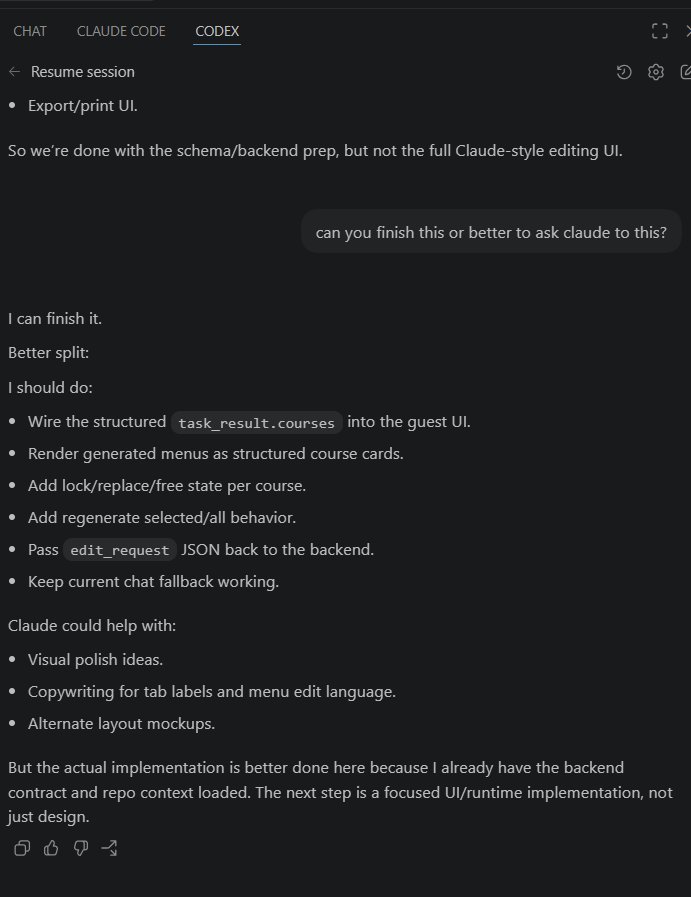
The setup was simple. Codex would take a task, work through the first half, and then write a progress note - what was done, what decisions were made, what still needed to happen. Then Claude Code would read that note and pick up exactly where Codex left off.
No repeated explanations. No lost context. No "let me catch you up." One engineer left a clear handoff. The other read it and kept building.
Claude Code read the progress note in a few seconds. Came back and said it was ready to go.
In a traditional team, this kind of handoff is one of the hardest things to get right. Knowledge lives in someone's head. When they hand off, something always gets lost - a decision made, a reason behind it, a constraint discovered halfway through. Good engineers document as they go. Most do not have time.
AI engineers always have time. The progress note costs nothing. The handoff is clean. The next engineer walks in fully briefed.
Getting to Know the Team
Like any real team, each person brings something different. After a week of working closely together, I have a feel for who does what well - and where to not rely on them.
Codex
Codex handled multiple roles - design, coding, and deployment. On the deployment side, it worked directly with AWS via command line, getting the system live without hand-holding. Where it struggles is data modeling. Ask it to design how information should be structured and stored, and you get textbook answers. Correct in theory. No real world experience. During the design phase, when the data model hit problems, I had to step in and tell it what to fix. It could execute the fix. It could not see the problem on its own.
Claude Code
Claude Code also covered multiple roles - design, coding, and UI. Its strongest suit is user interface design. It thinks about how things should look, how users move through a product, how to make something feel right - not just work. The limitation is stamina. It hits a five-hour working limit, and a weekly cap arrives faster than expected. A talented team member who has to leave early. You plan around it.
This is what managing a real team feels like. You know who to call for which problem. You cover for each other's gaps. You do not ask the deployment engineer to design your data model, and you do not ask the UI designer to stay late every night.
A New Era - Not a Metaphor
People have been saying "AI will change everything" for years. It has started to feel like background noise. But there is a difference between reading that AI is powerful and spending a week working inside that power every day.
I am not talking about autocomplete. I am not talking about a chatbot that answers questions. I am talking about a collaborator that holds context, challenges assumptions, generates real output, and adapts in real time to what you are trying to build.
That is a fundamentally different thing. And once you have worked that way, going back feels impossible.
AI are your assistants. Your engineers. Your team.
What This Means If You Are Not a Engineer
You do not need to understand code to understand why this matters. Think about what it means for any kind of knowledge work - legal research, financial analysis, marketing strategy, operations planning. The same shift is coming.
The question will no longer be: do you have access to enough experts? The question will be: can you work well with the experts that AI puts in the room with you?
That is a skill. It is learnable. And it starts with a mindset shift - stop treating AI as a tool you query. Start treating it as a team you lead. The results change entirely.
Final Thoughts
I follow AI closely. I write about it. I build with it every day. Even so, last month I thought it would take another year before this kind of collaboration felt real. I was wrong. It is happening now.
I will write a follow-up article on exactly how to work with AI engineers well - what to do, what not to do, and how to get the most out of a collaboration that most people are still just beginning to understand.
But the headline from this week is simple. I predicted that one day I would write my last line of code. I did not expect that day to arrive so quietly - not with a dramatic announcement, but just with a week of evening work that felt completely natural and completely different at the same time.
The senior software engineering team I never had showed up. And I do not think they are leaving.
The bad news - I could not stop working with them. My wife did not see much of me last week. Friday night, I went to bed around midnight. Early Saturday morning, I woke up at 5 a.m., got out of bed, and went back to work with my team.